


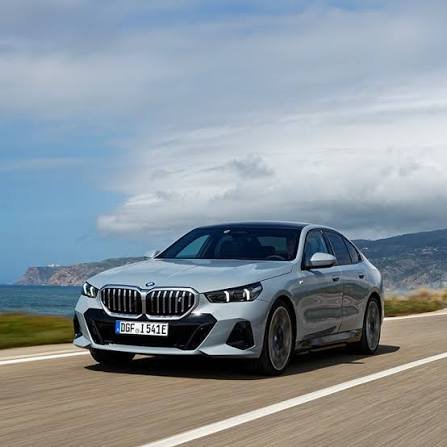
(Germany) –– BMW is entering a decisive phase in the electric-vehicle market as the German luxury automaker accelerates the rollout of its Neue Klasse platform while confronting tougher competition from Chinese EV manufacturers. In 2025, BMW Group delivered 442,059 fully electric vehicles worldwide, up 3.6% from a year earlier, while electrified vehicles including plug-in hybrids reached 642,071 units, an 8.2% increase. Fully electric vehicles represented 17.9% of total BMW Group deliveries, while electrified vehicles accounted for 26.1%.
The numbers show that BMW is no longer treating electric vehicles as a niche segment, but the transition is still being managed alongside combustion engines and plug-in hybrids. The company has adopted a technology-neutral strategy that allows it to serve markets where EV adoption is advancing at different speeds. By the end of 2026, BMW Group expects to offer 20 fully electric models across its brands, creating a broader portfolio as the company moves deeper into the next stage of electrification.
At the centre of that strategy is Neue Klasse, BMW’s most significant product and technology programme in years. The first production model, the fully electric BMW iX3, entered the market as the initial vehicle based on the new architecture, with the BMW i3 following as the second model. BMW plans to extend Neue Klasse technologies across its broader portfolio, with more than 40 new or updated models scheduled through 2027.
The technology underpinning Neue Klasse is designed to address some of the main weaknesses that have historically constrained EV adoption: range, charging time, efficiency and cost. BMW’s sixth-generation eDrive system uses newly developed cylindrical battery cells, an 800-volt electrical architecture and a new battery-pack structure. The company says the technology can increase range by 30%, accelerate charging by 30% and reduce high-voltage battery costs by 40% to 50% compared with the previous generation.
The new BMW iX3 illustrates the scale of that technological shift. The iX3 50 xDrive has a maximum WLTP range of up to 805 kilometres, while BMW says its 400-kilowatt charging capability can add as much as 372 kilometres of range in 10 minutes under suitable conditions. The system also introduces bidirectional charging, allowing the vehicle to function as an energy-storage device and potentially feed electricity back into homes or other applications.
BMW is also trying to reduce the cost disadvantage of electric drivetrains. Its Gen6 electric motors and battery architecture are designed around a more scalable technology platform, while the company says the new system can reduce energy losses by 40% and vehicle weight by 10% in certain configurations compared with previous-generation xDrive technology. The objective is not simply to produce more EVs, but to create a common architecture capable of supporting multiple body styles and performance levels.
The timing is important because BMW is facing a rapidly changing competitive landscape. Chinese manufacturers have shortened vehicle development cycles, expanded their EV portfolios and pushed technologies such as fast charging, software and digital interfaces into the centre of the competition. Reuters reported in 2026 that BMW has faced particular pressure in China, where local EV manufacturers have been gaining market share and developing new models at a faster pace.
China is therefore one of the biggest tests of BMW’s EV strategy. BMW Group delivered about 625,000 vehicles in China in 2025, while overall group sales in the country declined 12.5%, compared with growth of 7.3% in Europe and 5.6% in the Americas. BMW has responded by increasing local sourcing, consolidating development and purchasing activities and placing greater emphasis on local relevance, speed and software.
The challenge in China is also strategic rather than purely technological. Chinese consumers increasingly expect vehicles to function as connected digital products, with software, intelligent driving systems, entertainment and rapid product cycles becoming important elements of the purchase decision. BMW has acknowledged the need to increase local relevance and software capabilities, while its China operations already include local vehicle production, battery activities and development through its joint venture structure.
Europe provides a different picture. In 2025, BMW Group’s fully electric sales in Europe increased by more than 28%, while BEVs and plug-in hybrids together represented about 40% of the group’s European sales. That regional performance gives BMW a significant installed base and a market in which the Neue Klasse rollout can potentially accelerate the conversion of existing customers to fully electric models.
BMW’s approach also differs from a pure-EV strategy because the company is continuing to invest across multiple propulsion technologies. Plug-in hybrids remain part of the product portfolio, while combustion-engine vehicles continue to serve markets where charging infrastructure, customer demand and government policies have not moved at the same pace. BMW has also said that hydrogen fuel-cell technology will enter its portfolio from 2028, reinforcing its broader technology-neutral approach.
The strategy carries a substantial manufacturing dimension. BMW is applying a “local for local” approach to the Neue Klasse battery supply chain, with Gen6 battery production planned or established near vehicle plants in Germany, Hungary, China, Mexico and the United States. The geographic structure is intended to reduce exposure to geopolitical disruption while allowing BMW to adapt production more closely to regional demand.
The company is simultaneously using electrification to reshape its manufacturing network. The Neue Klasse programme requires BMW to introduce new battery technologies, electric-drive components, software and vehicle architectures without abandoning its existing production capabilities. This creates a difficult capital-allocation problem: BMW must fund the transition while protecting margins in a market where price competition, tariffs, supply-chain costs and weaker demand in some regions are putting pressure on profitability.
The stakes are particularly high because BMW’s long-term target is considerably more ambitious than its current EV mix. The company has set a 2030 target of having more than 50% of its vehicle deliveries fully electric, compared with 17.9% in 2025. BMW also says it expects to deliver more than 10 million fully electric vehicles to customers cumulatively by 2030, indicating the scale of the transition it is preparing to execute.
The early performance of Neue Klasse will therefore be closely watched by investors, suppliers and competitors. BMW says demand for the iX3 has been strong, with around one in three fully electric BMW vehicles ordered in Europe since its 2025 world premiere being an iX3, while production at the Debrecen plant in Hungary has already moved to two shifts. The company is betting that its engineering, brand equity and new technology platform can translate into sustained EV demand rather than simply replacing combustion-engine models with electric equivalents.
The competitive test, however, will extend beyond range and charging speed. BMW must compete simultaneously on vehicle price, software, artificial intelligence, autonomous-driving capability, battery economics, manufacturing scale and the speed at which new features reach customers. The emergence of Chinese EV makers has changed the benchmark for product development, making technological quality alone insufficient if the company cannot match the pace of innovation and localisation in key markets.
BMW’s EV manoeuvre is therefore less about making a single successful electric model than about rebuilding the economics and architecture of its global automotive business. Neue Klasse provides the technological foundation, Gen6 provides the battery and charging platform, and the company’s multi-powertrain strategy provides flexibility while EV adoption remains uneven across markets. The next three years, as more than 40 new or updated models arrive and Neue Klasse technology spreads across the portfolio, will determine how effectively BMW can convert its engineering advantage into scale in an increasingly competitive EV industry.