
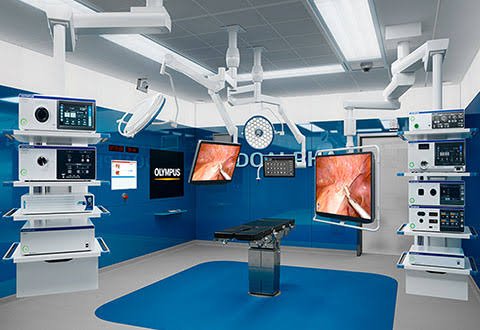
(Tokyo) — Japan’s medical equipment industry is becoming increasingly global, with manufacturers expanding far beyond their traditional domestic market. Japanese companies have developed strong positions in medical imaging, endoscopy, cardiovascular devices, laboratory diagnostics and healthcare information systems. Five names stand out for their international reach and distinctive technological strengths: Olympus, Terumo, Sysmex, Canon Medical Systems and Fujifilm.
Olympus is one of Japan’s most internationally recognized medical technology companies, particularly in gastrointestinal endoscopy. The company has increasingly transformed itself into a focused medical technology group after moving away from its former consumer camera business. In fiscal 2026, Olympus reported consolidated revenue of approximately ¥1.01 trillion, with North America accounting for about 40% of revenue and Europe another 28%, illustrating the company’s highly international business structure.
Olympus’ strength lies in technologies used for diagnosis and minimally invasive treatment. Its gastrointestinal solutions generated approximately ¥697.4 billion in fiscal 2026, while surgical and interventional solutions contributed another ¥313.1 billion. The company continues to expand its endoscopy and therapeutic technology portfolio, including through acquisitions and global distribution agreements designed to broaden its presence in areas such as respiratory and urological procedures.
Terumo has built a different global position by combining a broad portfolio of medical devices with cardiovascular and blood-management technologies. Founded in 1921, the company now operates across areas including cardiovascular systems, vascular grafts, blood bags, disposable medical devices, peritoneal dialysis, glucose monitoring and medical electronics. Terumo reported revenue of approximately ¥1.13 trillion for fiscal 2026 and had more than 31,000 employees on a consolidated basis.
Cardiovascular medicine is one of Terumo’s most important areas of technological development. Its products are used in procedures involving blood vessels and the heart, giving the company exposure to a global healthcare market driven by ageing populations, cardiovascular disease and the increasing use of minimally invasive procedures. Its business model also combines specialized devices with relationships involving hospitals, physicians and healthcare systems.
Sysmex has established one of Japan’s strongest positions in medical diagnostics rather than conventional hospital equipment. The Kobe-based company specializes primarily in in-vitro diagnostics using blood and urine samples, with products distributed across more than 190 countries and regions. Sysmex reported fiscal 2026 net sales of ¥500 billion, with overseas sales accounting for 88.3% of the total.
Sysmex is particularly strong in hematology, hemostasis and urinalysis. The company says it holds a global leading position across these three diagnostic fields, while its hematology business has a global market share of more than 50%. Approximately 3 billion tests are performed annually using its hematology instruments, according to the company’s estimate. Its strategy combines instruments, reagents, information technology and long-term customer support, creating recurring business beyond the initial sale of laboratory equipment.
Canon Medical Systems represents Japan’s strength in medical imaging technology. Its portfolio includes CT scanners, MRI systems, ultrasound diagnostic equipment and X-ray systems, as well as laboratory equipment and healthcare IT solutions. The company has established an international network spanning North America, South America, Europe, Africa and the Middle East, Asia and Oceania, and supports customers in more than 190 countries and regions.
Medical imaging is becoming increasingly connected to software and artificial intelligence, creating a new competitive arena for Canon Medical. Hospitals are looking not only for imaging hardware but also for systems that can improve diagnostic workflows, image quality and clinical efficiency. Canon’s combination of imaging technology, healthcare IT and international service infrastructure gives it a broad platform for expansion.
Fujifilm has taken perhaps the most diversified approach among the five companies. The group has leveraged its expertise in imaging technology to build a major healthcare business covering medical imaging systems, endoscopy, ultrasound, laboratory equipment and healthcare information systems. Fujifilm Medical also provides maintenance and repair services, allowing the company to build relationships with healthcare institutions beyond the initial equipment sale.
Fujifilm’s transformation is particularly significant because the company has moved from its historical identity as a photographic film manufacturer toward a broader technology and healthcare group. Its medical business now combines hardware, software, imaging technologies and healthcare IT. This diversification gives Fujifilm multiple entry points into hospitals and diagnostic facilities as healthcare systems increasingly digitize.
The five companies therefore demonstrate five different models of Japanese medical technology. Olympus has built its global franchise around endoscopy and minimally invasive procedures, Terumo around cardiovascular and medical devices, Sysmex around laboratory diagnostics, Canon Medical around diagnostic imaging, and Fujifilm around imaging, endoscopy and healthcare information technology. Their competitive positions are not identical, but each has developed a clear technological specialization.
International expansion is central to their business models. Data compiled by Japan’s Ministry of Economy, Trade and Industry showed that several leading Japanese medical device companies already generate a majority of their sales outside Japan. In fiscal 2022, the overseas-sales ratios cited by METI were 84% for Olympus, 71% for Terumo, 72% for Canon Medical and 85% for Sysmex.
The high overseas exposure reflects the structure of the medical equipment industry itself. Unlike many consumer products, sophisticated medical equipment requires regulatory approvals, physician training, hospital relationships, technical maintenance and long-term customer support. Once a manufacturer establishes these capabilities in a foreign market, it can build a substantial installed base that supports recurring demand for consumables, reagents, maintenance and upgrades.
Asia is becoming an increasingly important market for these Japanese companies. Hospitals across Southeast Asia, India and other emerging markets are investing in diagnostic imaging, laboratory automation, endoscopy and cardiovascular care. At the same time, ageing populations in Japan, China, South Korea and parts of Southeast Asia are increasing demand for technologies related to cancer, cardiovascular disease and chronic conditions.
Indonesia is particularly relevant to this expansion. The country has a large population, a growing private hospital sector and increasing demand for advanced diagnostic and treatment technologies. Japanese medical technology companies therefore have opportunities not only to sell equipment but also to develop distribution networks, technical service capabilities, training programs and partnerships with hospitals.
The business opportunity extends beyond selling machines. Medical equipment companies increasingly generate value through software, data management, consumables, reagents, maintenance and recurring service contracts. Sysmex provides a clear example because its diagnostic instruments create an ongoing demand for reagents and customer care, while imaging and endoscopy manufacturers can generate continuing revenue through accessories, service and technology upgrades.
Artificial intelligence is also changing the competitive landscape. Medical imaging companies are integrating AI into diagnostic workflows, while laboratory equipment manufacturers are using automation and software to improve testing capacity. Endoscopy companies are also developing technologies that can assist physicians during examinations and procedures. As a result, Japanese medical technology companies are increasingly competing as healthcare technology providers rather than simply as hardware manufacturers.
Another important trend is the move toward minimally invasive medicine. Hospitals are seeking technologies that can reduce procedure times, shorten hospital stays and improve patient outcomes. Olympus and Terumo are particularly exposed to this trend through their respective strengths in endoscopy, interventional procedures and cardiovascular technologies.
The competitive environment is nevertheless becoming more international. Japanese manufacturers compete with large American and European medical technology companies as well as rapidly developing manufacturers from other Asian economies. Their response has increasingly involved product innovation, acquisitions, global partnerships and expansion of local sales and service capabilities.
For investors and healthcare companies, the differences among the five Japanese groups are significant. Olympus provides exposure to endoscopy and minimally invasive procedures, Terumo to cardiovascular and medical devices, Sysmex to laboratory diagnostics, Canon Medical to diagnostic imaging, and Fujifilm to a broader combination of imaging, endoscopy, diagnostics and healthcare IT. The changing global healthcare market therefore creates different opportunities across each company’s technology portfolio.
Japan’s medical equipment industry ultimately demonstrates how the country’s manufacturing capabilities can evolve into global healthcare technology businesses. These companies combine engineering, precision manufacturing, regulatory expertise, software, clinical applications and international service networks. As healthcare systems across Asia and other emerging markets invest in diagnostics and advanced treatment, Olympus, Terumo, Sysmex, Canon Medical and Fujifilm are expanding from Japanese manufacturers into increasingly global medical technology companies.
