
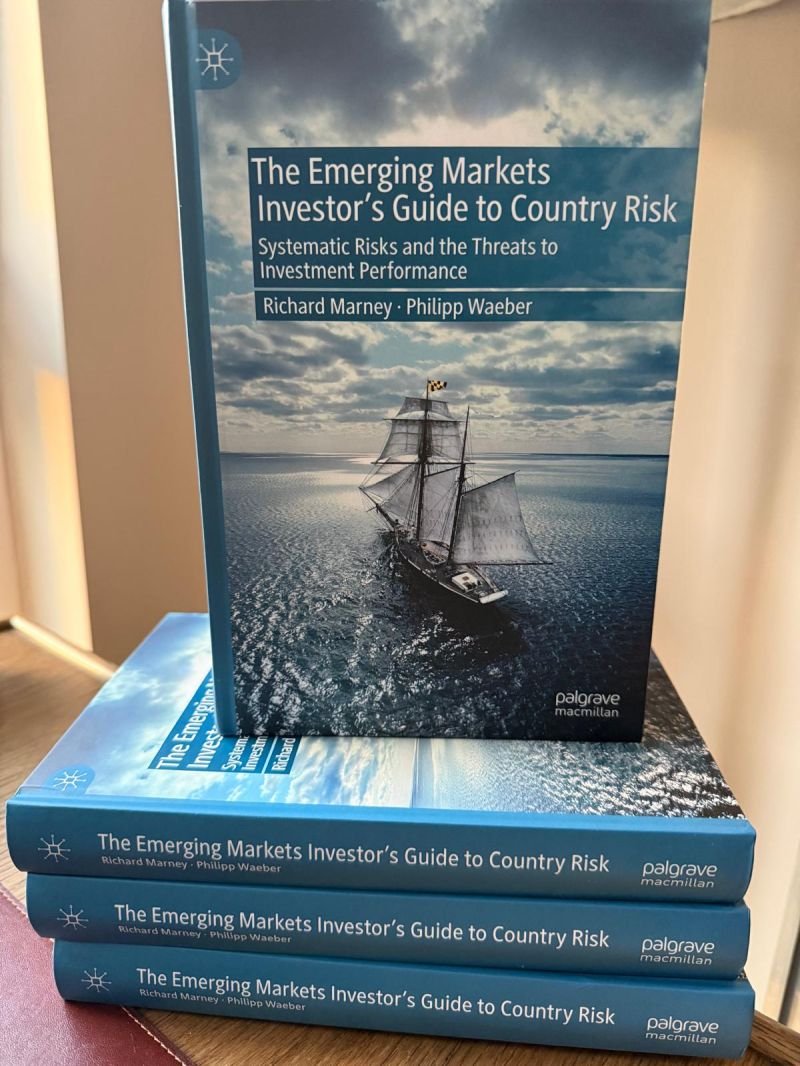
(Singapore) — At a time when global investment is increasingly shaped by trade wars, geopolitical shifts, interest rates, technology, climate change and changing supply chains, country risk has become increasingly difficult to reduce to a single number or ranking. This is the central issue addressed by Richard Marney and Philipp Waeber in The Emerging Market Investor’s Guide to Country Risk: Systematic Risks and the Threat to Investment Performance, published by Palgrave Macmillan in 2026. The book, which runs to nearly 400 pages, offers a more dynamic approach to understanding country risk, particularly across emerging markets and developing economies, or EMDEs.
The book’s central argument is important because country risk is often treated as a snapshot rather than a moving picture. Investors may look at economic growth, inflation, government debt, political stability, exchange rates or credit ratings at a particular point in time and then use those indicators to make investment decisions. Marney and Waeber instead encourage investors to examine how these factors evolve, interact and ultimately change the risks and opportunities associated with an investment.
That approach has become increasingly relevant because systemic risks can have a much greater impact on investment returns than risks originating from an individual company or project. A company may have strong management, a healthy balance sheet and an attractive market outlook, but changes in government policy, currency crises, trade disruptions, institutional weakness or geopolitical developments can alter the entire investment case. The book seeks to help investors understand the relationship between macroeconomic conditions, politics, institutions, financial systems and investment performance.
The structure of the book indicates that its discussion goes beyond conventional country-risk theory. The opening sections examine the macroeconomic fundamentals of EMDEs, institutions, financial-sector development, financial crises and the investment climate. The later sections move toward structural issues including geopolitical and geo-economic changes, climate change, demographics and the impact of technology on future economic growth models.
One of the most interesting elements is the concept of the Investor’s Rutter. The authors use this framework to help investors examine the interaction between economic, political, institutional and financial factors over time. Rather than attempting to make a perfect prediction about where a country is heading, the approach provides a structured way to distinguish temporary market volatility from structural changes that could fundamentally alter investment prospects.
The framework has important implications for investment appraisal. A rise in inflation or a weakening currency over several quarters, for example, does not necessarily mean that a country is undergoing a structural transformation. By contrast, changes in policy regimes, institutional strength, trade relationships, demographics or technology can alter a country’s long-term attractiveness. Investors therefore need to identify the point at which their existing assumptions about a country may no longer reflect its underlying investment environment.
The book is also notable for its discussion of transaction lives, counterfactuals and case studies. For direct investors, this approach can be more useful than simply relying on a country-risk index because investments have long lives. An acquisition, infrastructure project, corporate financing, private-equity investment or manufacturing facility may have a five-, 10- or even 20-year horizon, meaning that the conditions prevailing when an investment is made may be very different from those confronting an investor at exit.
Richard Marney’s professional background is one reason the book deserves attention. Springer describes Marney as having around five decades of experience spanning commercial and investment banking, microfinance, impact investment asset management and private equity, including experience with institutions such as BNY Mellon and JPMorgan. He has also served as Chief Risk Officer at responsAbility Investments and has held positions on boards, investment committees and advisory committees.
Marney is also not a newcomer to emerging-market risk. Together with Timothy Stubbs, he previously published Corporate Debt Restructuring in Emerging Markets: A Practical Post-Pandemic Guide in 2021 and Debt Restructuring in Emerging Markets: Effectively Navigating Local Institutional Frameworks in 2024 through Palgrave Macmillan. That track record suggests that his focus on country risk, debt restructuring and local institutions is closely connected to his professional experience rather than being purely an academic exercise.
Philipp Waeber brings a complementary perspective. He is identified by Springer as Chief Economist at responsAbility Investments and has nearly two decades of experience as an economist, focusing on how crises emerge, develop and affect companies within individual countries. He has also been involved in investment decisions and credit structuring aimed at assessing and mitigating country risk, holds a master’s degree in economics from the University of Fribourg and is a CFA charterholder.
For investors, perhaps the book’s greatest value lies in changing the way risk is viewed. Its framework can be used during country screening before entering markets such as Indonesia, Vietnam, India, the Philippines, Malaysia, Africa or Latin America, and then applied again during due diligence on individual companies and projects. Country risk therefore becomes a factor to be monitored throughout the investment life cycle rather than an appendix added to an investment memorandum.
The book’s relevance is particularly strong for investors in Asia because many economies in the region are undergoing structural changes simultaneously. Global supply-chain shifts, U.S.-China competition, growing power requirements for data centers and AI, demographic changes, energy transitions and trade policies can all reshape a country’s competitiveness. For investors with five- to 10-year horizons, The Emerging Market Investor’s Guide to Country Risk is therefore better understood as a framework for continuously testing investment assumptions rather than a book designed to produce a single risk score or market forecast. (NB)
